Most food brands begin the same way. Someone makes something people ask for a second time. Friends buy it, a market stall sells out, a local cafe puts it on the counter, and somewhere in there a real business starts forming around a recipe that was never designed to be a business.
The gap between that moment and a product sitting on a national shelf is wider than it looks — and it is rarely about the recipe. It is about everything the recipe has to survive on the way there.
Here is an honest map of that journey, written from the manufacturing side of it.
Scaling a recipe is a reformulation, not a multiplication
The first hard lesson is that a recipe does not scale linearly. A relish that works beautifully in a ten-litre pan behaves differently in a five-hundred-litre kettle, because heat transfer, evaporation rate and reduction time all change.
Ingredients behave differently too. Home cooking absorbs natural variation — a slightly acidic batch of tomatoes, an onion crop with higher sugar — because the cook tastes and adjusts. Production cannot do that at scale and still deliver a consistent jar. So the recipe has to be rebuilt with specifications rather than instincts: target Brix, pH bands, viscosity ranges, defined cook curves.
That process usually improves the product. But it does mean handing a treasured recipe to people who will ask uncomfortable questions about it, and founders should go in expecting that.
Food safety is a system, not a certificate
Any commercial manufacturer in Australia works within a HACCP-based food safety programme, operates to the Food Standards Australia New Zealand Code, and very often holds a third-party certification such as SQF, BRCGS or HACCP certification depending on who they supply.
For a brand owner, the practical implication is this: major retailers and many distributors will not list you without evidence of a compliant supply chain. That evidence includes traceability from raw material to finished pallet, allergen control, verified thermal processing, environmental monitoring and documented corrective actions.
Building that from scratch is a multi-year, capital-heavy exercise. Renting it — by producing through an already certified partner — is how most brands reach market inside a realistic timeframe.
Labelling is where good brands lose months
Australian food labelling is unforgiving, and it is the single most common reason a launch slips.
You will need a compliant nutrition information panel, an ingredient list in descending order of ingoing weight, allergen declarations that meet current plain-English requirements, country of origin labelling with the correct bar chart and percentage where applicable, accurate net weight and measurement marking, a date mark supported by real shelf life data, and lot identification that ties back to production records.
Every claim on the front of the pack has to be substantiated too. Gluten free in Australia means no detectable gluten — a stricter standard than in several other markets, and it needs testing behind it. No added preservatives needs formulation and shelf life work to stand up. Australian Made has specific rules about substantial transformation.
None of this is impossible. All of it takes longer than founders expect, and most of it must be settled before artwork goes to print.
Packaging decisions you cannot easily reverse
Jar or bottle, glass or PET, lug cap or continuous thread, shrink sleeve or wraparound label — these look like design choices and are actually operational ones. Closure type determines which filling line can run your product. Container geometry determines case configuration, which determines pallet efficiency, which shows up on every freight invoice you will ever pay.
Choose a bespoke container and you own the tooling, the minimum order quantity and the lead time risk. Choose a standard container and you gain flexibility and speed, at the cost of a slightly less distinctive silhouette. Both are legitimate. Just make the choice knowing what it commits you to.
Unit economics decide everything else
Work backwards from the shelf, not forwards from the kitchen. Take a realistic retail price for your category, remove GST, remove retailer margin, remove distributor margin, remove promotional allowance, remove freight — and see what is left to cover ingredients, packaging, labour, overhead and your own margin.
Founders are often surprised by how little of the retail price reaches them, and by how much of their cost sits in packaging rather than food. Run this calculation early. It will tell you whether the product needs reformulating, repricing, resizing, or a different route to market entirely.
Build a facility, or partner with one
A brand that builds its own plant gains control — and gains a fixed cost base that must be fed with volume from day one. A brand that partners with an established manufacturer trades some control for speed, certification, purchasing power and the ability to fail cheaply on a flavour that does not work.
For most emerging brands, partnering first and building later, if ever, is the lower-risk path. It also means capital goes into demand generation rather than stainless steel.
Brand development is not a logo
The last piece is the one most often left too late. Positioning, pack architecture, price laddering, range strategy, channel plan and the story that makes a buyer say yes — these need to be settled before production, because they determine what you produce and in what format.
Where Niora Foods fits
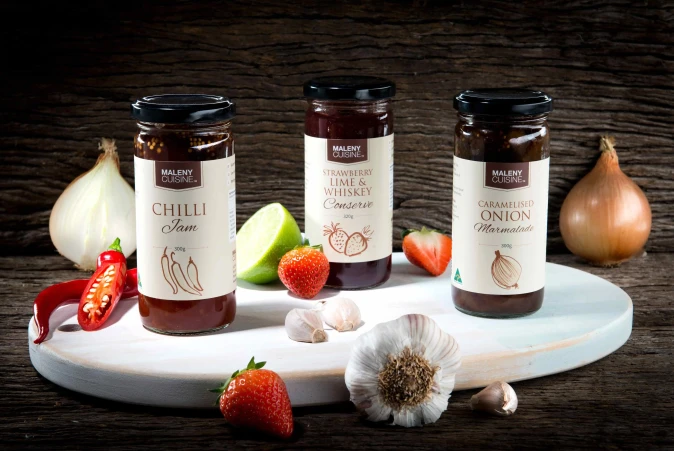
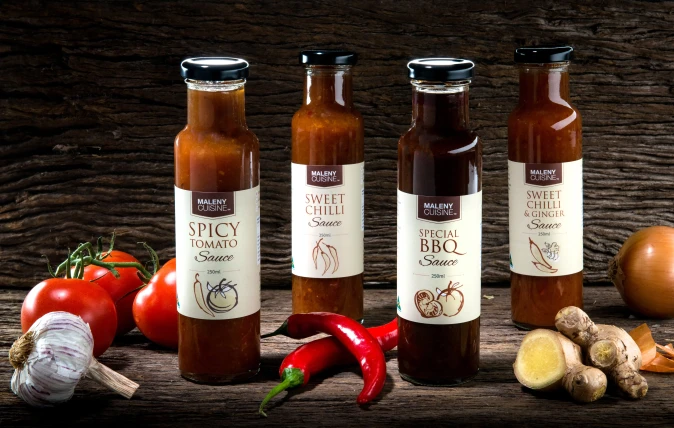
Niora Foods works across manufacturing, importing, wholesale distribution and brand development, so a brand can enter at whichever stage it needs and draw on the rest as it grows. We make our own brands — including Maleny Cuisine, produced on the Sunshine Coast since 1988 — which means the systems we would run your product through are the ones we rely on ourselves.
If you have a product people keep asking for and no clear path to scale it, start a conversation with us. Bring the recipe, the numbers and the questions.